5 Podcasts to Help You Learn Language on the Go
397 views
The most annoying part of language learning isn't always the grammar.
It's finding the time.
You download an app, buy a course, promise yourself you'll study after work—and then the day disappears. The commute is noisy. Dinner needs making. By the time you're free, your brain has quietly gone on strike.
Podcasts offer a different route.
They won't magically make you fluent while you're folding laundry. Nothing does. But they can turn otherwise wasted stretches of the day into repeated contact with your target language, which is a much more useful proposition than waiting for the mythical “perfect study session.”
That makes podcasts a strong companion to the practical approach behind Language Fluency: use the tools that fit real life, not just the ones that look impressive in a study plan. The site already covers practical fluency, vocabulary, pronunciation, grammar, culture, and immersive learning strategies, so this guide takes a narrower angle—five audio resources worth using when you're away from your desk.
Why podcasts work differently from a normal lesson
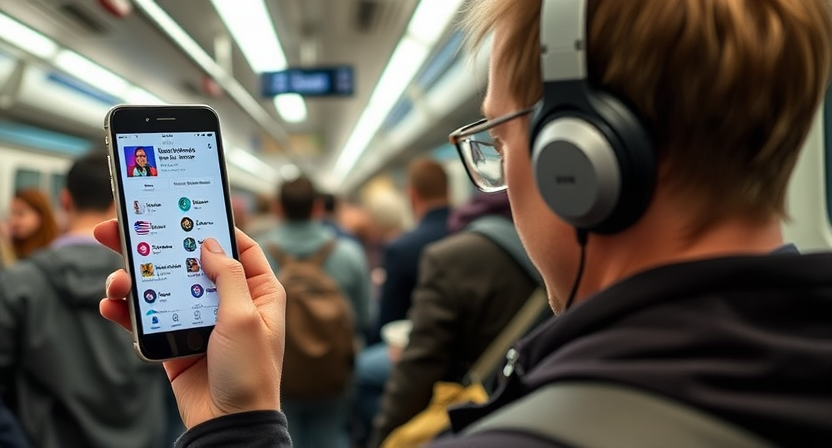
Audio has an obvious limitation. You can't see spelling, facial expressions, or sentence structure while you're walking through a crowded station.
That limitation can become useful.
A podcast forces you to deal with the language as sound. Rhythm. Stress. Connected speech. The frustrating little moments when you know every word individually but still have no idea what the speaker just said.
Research on podcast-based language learning has also found evidence that structured podcast use can support vocabulary development and listening skills, although listening alone is not a complete replacement for reading, speaking, or active practice.
The trick is matching the podcast to the moment.
A grammar-heavy episode is fine while sitting with a notebook. It's a poor choice while carrying groceries. An intermediate story with occasional English context, on the other hand, can work beautifully on a 25-minute walk.
Here are five options that approach the problem from different directions.
1. Coffee Break Languages — best for structured learning in short sessions
If you like the idea of a teacher guiding you through the language instead of simply dropping you into native-speed conversation, Coffee Break Languages is an easy place to start.
The format is deliberately built around manageable listening sessions. Coffee Break French, Spanish, Italian, Chinese, and other courses offer free podcast content, with many lessons designed around roughly 15–20 minutes of audio.
That length matters more than it sounds.
A 20-minute episode is short enough to finish during a commute but long enough to introduce a concept, hear it used, and revisit it. The learner-and-teacher format also creates a useful bit of friction: you'll often hear another learner make the kind of pronunciation or grammar mistake you're about to make yourself.
The free version versus the paid materials
The podcasts themselves are free. Paid course materials add resources such as bonus audio, lesson notes, video lessons, vocabulary support, exercises, and pronunciation practice, depending on the course. Current official pricing pages list a 40-lesson season at £199 or $269 for some flagship courses, while the broader Coffee Break product range also includes subscription-based video access.
You don't need the premium version to benefit.
Start with the free audio first. If you repeatedly find yourself wishing you could check spelling, review vocabulary, or see a tricky grammar point written down, then the paid materials make more sense.
Best for: Beginners through intermediate learners who want direction rather than pure immersion.
One annoyance: Audio-only listening can leave you wondering how a word is spelled. Don't waste ten minutes guessing. Flag the timestamp and check it later.
2. Duolingo Podcast — best for story-driven intermediate listening
A vocabulary list can teach you the word misterio.
A good story gives your brain a reason to care about it.
That's the strength of the Duolingo Podcast archive. The series uses real stories and narrative formats, with target-language storytelling supported by context in the listener's other language. The archive currently contains more than 300 episodes across Spanish for English speakers, French for English speakers, English for Spanish speakers, and English for Portuguese speakers.
There is one catch: the series has been sunset, so you shouldn't expect a constant stream of new episodes.
The back catalog remains available, though, and that's hardly a disaster. A large archive can actually be better for systematic learners because you can choose a theme or season and work through it without waiting for next week's release.
Full transcripts are available for episodes, which is where the podcast becomes substantially more useful as a learning tool.
Try this:
Listen once without reading anything.
Revisit the episode later with the transcript and investigate only the parts that blocked your understanding.
Don't translate every sentence. That's the trap.
You're training comprehension, not preparing evidence for a court case.
Best for: Learners around the lower-intermediate to intermediate range who can follow a story with some support.
Why it stands out: You'll encounter accents, cultural references, and natural phrasing inside an actual narrative rather than isolated example sentences. Some episodes even call attention to regional pronunciation features, which is useful once you move beyond the textbook version of a language.
3. News in Slow — best if normal news feels too fast
There's a specific stage of language learning where beginner dialogues become boring, but ordinary news podcasts are still a blur.
News in Slow-style programming is built for that uncomfortable gap.
The basic idea is simple: use current affairs, culture, and discussion topics while controlling the difficulty and pace more carefully than a standard native-speaker news broadcast. That gives you material with real-world content without immediately throwing you into dense vocabulary, rapid speech, overlapping voices, and names you can't spell.
This is particularly useful for learners who are tired of ordering imaginary coffees.
The better strategy is not to listen passively every day. Pick two or three episodes a week and recycle them. Listen during your first commute. Later, replay one difficult section. On the third pass, try shadowing a short sentence aloud when you're somewhere you won't look completely unhinged.
A quiet walk is ideal.
A packed elevator? Maybe not.
Best for: Intermediate learners who want a bridge between lessons and native media.
Watch out for: News vocabulary can be highly specific. If an episode is full of election terminology, financial regulation, or military vocabulary, don't assume every unknown word deserves a flashcard.
Some words are useful immediately. Some can wait.
4. Easy German, Easy Spanish, and the wider Easy Languages format — best for hearing real people
Scripted learner audio is useful. Real street interviews are a different animal.
The Easy Languages format is particularly valuable because it exposes learners to ordinary speakers discussing ordinary things: habits, opinions, relationships, work, food, local customs, and whatever else happens to come up.
That means interruptions.
Different accents.
People changing direction halfway through a sentence.
Exactly the stuff textbooks tend to clean up.
For learning on the go, audio from these formats works best once you're no longer dependent on understanding every sentence. Download or queue an episode, listen without looking at subtitles, and accept that some parts will escape you.
Then revisit the corresponding video later.
That second stage matters. Seeing the subtitles after an audio-only attempt creates a useful “oh, that's what they said” moment—the kind that gradually helps connected speech stop sounding like one very long word.
Best for: Intermediate and advanced learners who need more contact with natural variation.
Real-world friction: Native speech can feel wildly inconsistent. One speaker is crystal clear; the next one swallows half the sentence. Don't judge your level based on a single difficult voice.
5. Language Transfer — best for understanding how the language fits together
Some podcasts teach you phrases.
Language Transfer often asks you to build them.
That distinction is huge if you've reached the point where memorizing another list of disconnected vocabulary feels increasingly pointless. The audio lessons use a guided, problem-solving approach, encouraging learners to notice patterns and make connections rather than simply repeat after a speaker.
It's especially effective when your commute involves enough mental space to think.
Don't put on a reasoning-heavy lesson while navigating an unfamiliar airport. You'll either miss the lesson or board a flight to the wrong country.
A 15-minute walk is better.
Pause when prompted. Answer out loud. Guess before the explanation arrives. If you're wrong, good. That failed attempt can make the correction more memorable than another polished repetition ever would.
Best for: Analytical learners and anyone who wants to understand grammar patterns without turning every session into a formal grammar lecture.
The limitation: This isn't your only source of listening practice. You still need exposure to natural voices, slang, regional pronunciation, and spontaneous conversation.
Think of it as mental scaffolding.
Not the finished building.
Don't just press play: a better mobile podcast routine
The easiest mistake is treating podcast listening as background noise and then assuming the hours automatically count as study.
Sometimes they do.
Often, not quite.
Use a simple three-part rotation instead:
First listen: Follow the episode without stopping. The goal is the big picture.
Second contact: Replay one difficult section or the full episode at another time.
Active follow-up: Save three useful phrases, shadow a short passage, or check the transcript.
That's enough.
You don't need to extract 47 vocabulary items from every episode. In fact, doing that usually makes the habit harder to sustain. A small number of phrases that you actually recognize later is far more useful.
For longer episodes, try adjusting playback speed carefully. Moving from 1.0x to 0.9x can help a difficult learner episode, while reducing native speech too aggressively may distort the rhythm you're trying to learn. On the other side, 1.1x or 1.2x can be useful once familiar material starts feeling sluggish.
Use the feature as a training tool, not a permanent crutch.
A quick comparison
Podcast or format | Best level | Strongest feature | Best listening situation |
|---|---|---|---|
Coffee Break Languages | Beginner–Intermediate | Structured lessons | Commute or daily walk |
Duolingo Podcast archive | Intermediate | Stories plus transcripts | Longer walk or commute |
News in Slow | Intermediate | Accessible current topics | Regular listening routine |
Easy Languages | Intermediate–Advanced | Natural speakers and variation | Audio first, video review later |
Language Transfer | Beginner–Intermediate | Pattern-based thinking | Focused walk or quiet commute |
FAQs
Can you really learn a language by listening to podcasts?
You can improve listening comprehension, vocabulary recognition, pronunciation awareness, and familiarity with natural speech. Podcasts alone won't cover everything. Pair them with reading, speaking, and some form of active review.
Should beginners use native-language podcasts?
Usually, no—not as their main learning material. Start with learner-focused audio such as Coffee Break Languages or Language Transfer, then gradually add slower or more supported native content.
Is it better to listen with or without a transcript?
Do both, but not simultaneously every time. Listen first without text to test comprehension. Use the transcript afterward to investigate what you missed.
How many times should I replay an episode?
Two or three passes are usually enough. If you're still catching almost nothing after that, the episode may simply be too difficult right now. Move on and return later.
Should I listen every day?
Daily exposure is useful, but consistency matters more than streak perfection. Five focused 15-minute sessions can beat a single two-hour binge followed by six days of nothing.
Put the podcast to work
Pick one of these podcasts based on your current level, not the one that sounds most impressive.
Then queue a single episode for tomorrow.
Listen once without touching the pause button. Later, replay the section that confused you most and pull out just a few phrases worth keeping. Do that repeatedly, week after week, and those dead minutes between places start becoming something much more valuable: regular contact with the language you're trying to make your own.
language learning podcasts
learn a language on the go
best language podcasts
listening practice
language fluency
language learning tips
vocabulary podcasts
learn languages anywhere
Found this helpful? Share it!