
From Casual to Heartfelt: Different Ways of Saying Thank You in Greek
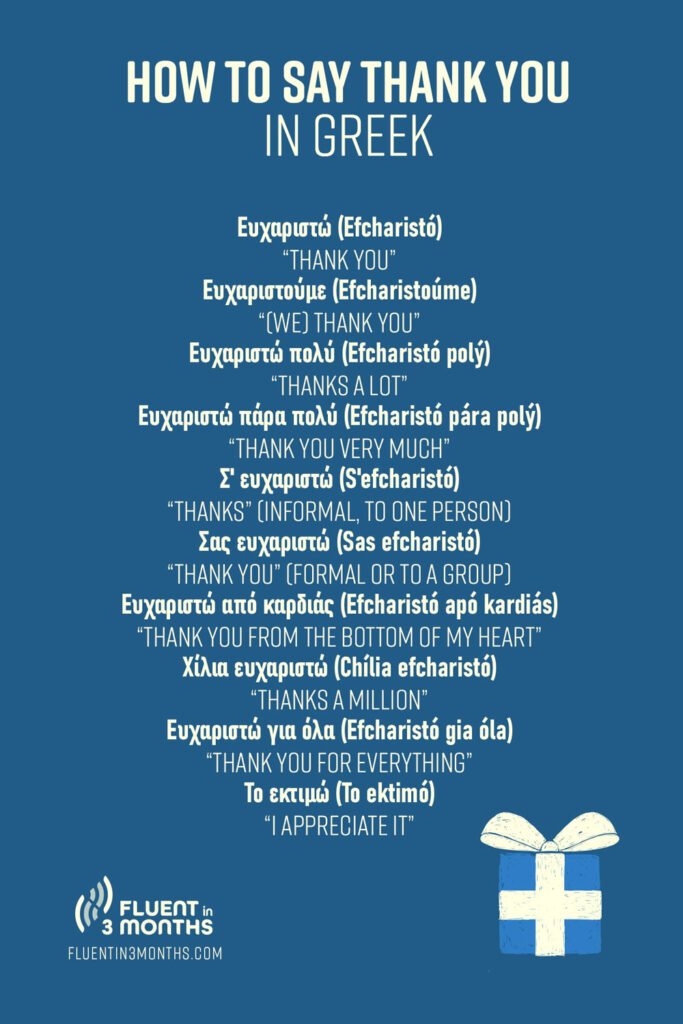
448 views
You’ve just been handed your coffee in Athens, rescued by a helpful stranger after getting off at the wrong metro stop, or invited to dinner by a Greek family. You know one word: Ευχαριστώ.
So you say it.
Then you say it again.
And again.
It works, of course. But after the fourth efcharistó, many Greek learners hit the same frustrating wall: Is this still natural? Should I sound warmer? More formal? More enthusiastic?
The good news is that Greek gives you plenty of room to adjust the emotional temperature of a simple “thank you.” A quick Ευχαριστώ can handle everyday transactions. Σας ευχαριστώ πολύ sounds more respectful. Σε ευχαριστώ από καρδιάς carries genuine feeling.
The trick is knowing which one fits.
For language learners, this is where memorizing a phrase stops being enough. You start noticing register, relationships, emphasis, and those small conversational choices that make your Greek sound less like a phrasebook and more like actual communication.
Start here: Ευχαριστώ
Ευχαριστώ
Efcharistó
Thank you / Thanks
This is the default. Safe, useful, and common.
The official Greek language dictionaries list ευχαριστώ both as the verb “I thank” and as the familiar standalone expression of gratitude. You can use it after receiving help, a gift, information, or a simple service.
A few everyday examples:
Ευχαριστώ! — Thanks!
Ευχαριστώ για τη βοήθεια. — Thank you for the help.
Καλά, ευχαριστώ. — Fine, thanks.
The stress falls on the final syllable: ef-cha-ri-STÓ. In IPA, the pronunciation is commonly represented as /ef.xa.ɾiˈsto/.
One small annoyance for English speakers: don't pronounce χ like the “ch” in chair. In ευχαριστώ, it is a rougher sound, closer to the sound some learners know from German Bach.
It may feel awkward at first. That's normal.
Want to add emphasis? Try πολύ and πάρα πολύ
Sometimes a plain thank you feels too small.
Maybe a hotel receptionist spent ten minutes sorting out your booking. Maybe a colleague covered your shift. Maybe someone returned the wallet you were absolutely certain you'd lost forever.
Add πολύ.
Ευχαριστώ πολύ
Ευχαριστώ πολύ
Efcharistó polí
Thank you very much
This is one of the most useful upgrades to your basic Greek. It sounds warm without becoming dramatic.
For stronger emphasis:
Ευχαριστώ πάρα πολύ
Efcharistó pára polí
Thank you so much / Thank you very, very much
Πάρα πολύ literally intensifies the “very much” idea. Greek learning materials commonly present Ευχαριστώ πάρα πολύ as a stronger expression of thanks.
Picture the difference:
The waiter brings your water.
Ευχαριστώ.
Your friend drives across town at 11 p.m. because your scooter won't start.
Ευχαριστώ πάρα πολύ!
Same core verb. Different weight.
Casual, formal, or plural? Add σε or σας
Here’s where English speakers often get tripped up.
Greek changes the form of “you” depending on whether you're speaking to one person informally or addressing someone formally or more than one person.
Σε ευχαριστώ
Σε ευχαριστώ
Se efcharistó
I thank you — informal, singular
Use it with a friend, family member, partner, or someone you address with εσύ.
Σε ευχαριστώ για όλα.
Thank you for everything.
Σας ευχαριστώ
Σας ευχαριστώ
Sas efcharistó
Thank you — formal singular or plural
This works when speaking respectfully to one person or naturally to several people.
Σας ευχαριστώ για τον χρόνο σας.
Thank you for your time.
The distinction follows the same informal/formal and singular/plural pattern found in other everyday Greek expressions, such as γεια σου versus γεια σας.
A practical shortcut: if you're unsure, Ευχαριστώ πολύ avoids the problem completely. You don't need to force σε or σας into every interaction.
For genuine warmth: words that go beyond “thanks”
Some situations need more than ευχαριστώ.
This is where Greek can sound wonderfully direct.
Σε ευχαριστώ από καρδιάς
Σε ευχαριστώ από καρδιάς
Se efcharistó apó kardhiás
I thank you from the bottom of my heart
Use this for meaningful support, emotional help, or a deeply appreciated gesture.
Από καρδιάς literally carries the idea of “from the heart.” The phrase isn't what you'd use for someone handing you a supermarket receipt. Context matters.
Σε ευχαριστώ μέσα από την καρδιά μου
Σε ευχαριστώ μέσα από την καρδιά μου
Se efcharistó mesa apó tin kardiá mou
I thank you from my heart
This is personal and heartfelt. The official dictionary includes μέσα απ' την καρδιά μου among examples of intensified gratitude.
Δεν ξέρω πώς να σε ευχαριστήσω
Δεν ξέρω πώς να σε ευχαριστήσω
Dhen kséro pos na se efcharistíso
I don't know how to thank you
This is useful when a plain “thank you” feels inadequate.
Maybe your host spent days helping you move. Maybe a teacher wrote you a recommendation. Maybe someone did something unexpectedly generous.
Then:
Δεν ξέρω πώς να σε ευχαριστήσω. Πραγματικά.
I don't know how to thank you. Really.
That final Πραγματικά — “really” — can add a natural touch without making the sentence sound like it came from a greeting card.
A very Greek-sounding option: να ’σαι καλά
Want something warmer and more conversational?
Try:
Να ’σαι καλά!
Na ’se kalá!
Thanks, you're a lifesaver / Bless you / May you be well
Literally, it means something like “may you be well.”
You'll often see it treated as an alternative expression of thanks, and it has a distinctly personal, friendly feel.
A simple exchange:
— Σου έφερα τον φορτιστή σου.
I brought you your charger.
— Α, να ’σαι καλά!
Ah, thanks! You're the best!
Don't use it as your only thank-you phrase. It has a relationship-dependent warmth. With a close acquaintance, friend, or helpful stranger in an informal setting? Great.
In a formal business email to a government office? Stick with Σας ευχαριστώ.
How to sound appreciative without sounding overdramatic
This is less about vocabulary than timing.
Greek speakers don't need a new phrase for every level of gratitude. Tone does a surprising amount of work.
Compare:
Situation | Natural Greek response |
|---|---|
Cashier gives you change | Ευχαριστώ |
Someone gives you directions | Ευχαριστώ πολύ |
A professional helps you | Σας ευχαριστώ πολύ |
A friend does you a big favor | Σε ευχαριστώ πάρα πολύ |
Someone provides emotional support | Σε ευχαριστώ από καρδιάς |
You feel deeply indebted | Δεν ξέρω πώς να σε ευχαριστήσω |
Short. Long. Formal. Emotional.
That's the real progression.
What do Greeks say back?
Learning “thank you” without learning the response is how conversations suddenly feel like they end in midair.
The most common answer is:
Παρακαλώ
Parakaló
You're welcome
But παρακαλώ does more work than English “you're welcome.” Depending on context, it can also mean “please” or function as a polite conversational response. Greek dictionaries describe ευχαρίστως as another standard polite response to a request, roughly equivalent to “with pleasure” or “gladly.”
You may also hear:
Εγώ ευχαριστώ
Egó efcharistó
No, thank you
That little εγώ adds emphasis: I’m the one who should be thanking you.
It's especially natural after a meeting, dinner invitation, or conversation where both people benefited.
— Ευχαριστώ για την πρόσκληση.
Thanks for the invitation.
— Εγώ ευχαριστώ που ήρθες.
No, thank you for coming.
Nice. Human. Easy to remember.
A quick pronunciation trap: don't let transliteration run the show
You'll see ευχαριστώ written as efcharistó, efharistó, and sometimes other variations depending on the transliteration system.
That's useful for getting started. It can also become a crutch.
Modern Greek pronunciation resources represent the word with /ef.xa.ɾiˈsto/, while native-speaker audio recordings are available through pronunciation platforms such as Forvo.
A better practice routine is:
Read Ευχαριστώ in Greek script.
Listen to a native pronunciation.
Repeat the entire rhythm, not isolated letters.
Record yourself once.
Compare.
The stress matters. ευχαρισΤΩ, not ΕΥχαριστώ.
That last vowel carries the landing.
Common mistakes learners make
Using the same phrase for everything.
Not wrong. Just limiting. Learn Ευχαριστώ, Ευχαριστώ πολύ, and one heartfelt option before collecting twenty obscure expressions.
Overusing formal language with friends.
Σας ευχαριστώ isn't offensive in an informal situation, but it can create unnecessary distance.
Translating English word for word.
“Much appreciated” doesn't need a rigid Greek clone every time. Often, Ευχαριστώ πολύ is the more natural choice.
Forgetting that a simple response can carry emotion.
A softly delivered Ευχαριστώ after a meaningful conversation may sound more sincere than a long sentence you've only memorized five minutes earlier.
And yes, that happens. A lot.
FAQs About Saying Thank You in Greek
How do you say “thank you” in Greek?
The standard phrase is Ευχαριστώ (Efcharistó). It works in most everyday situations.
How do you say “thank you very much” in Greek?
Say Ευχαριστώ πολύ for “thank you very much,” or Ευχαριστώ πάρα πολύ for stronger emphasis.
What's the difference between Σε ευχαριστώ and Σας ευχαριστώ?
Σε ευχαριστώ is informal and directed at one person. Σας ευχαριστώ is used formally with one person or when thanking multiple people.
What does Να ’σαι καλά mean?
Να ’σαι καλά literally means “may you be well,” but in casual conversation it can function as a warm, friendly expression of thanks.
How do you say “thank you from the bottom of my heart” in Greek?
A natural expression is Σε ευχαριστώ από καρδιάς or Σε ευχαριστώ μέσα από την καρδιά μου, depending on the level and style of emotion you want to express.
The next time you practice Greek, don't just memorize Ευχαριστώ and move on. Try saying the same basic message five different ways: quick, polite, enthusiastic, formal, and heartfelt. Then listen for those distinctions in real conversations. That's where vocabulary starts turning into fluency.
thank you in Greek
Greek thank you phrases
Greek expressions
how to say thank you in Greek
Greek language
Greek vocabulary
Greek phrases
learn Greek
Found this helpful? Share it!