
From Dawn to Dusk: How to Say Hello in Turkish
2,695 views
You finally work up the nerve to greet someone in Turkish. You remember one word—merhaba—say it confidently, and then the conversation immediately moves faster than your listening skills can handle.
Annoying? Absolutely.
The good news is that learning how to say hello in Turkish isn't really about memorizing one translation for “hello.” Turkish greetings shift with the time of day, the relationship, the setting, and sometimes even what the other person is doing. Say the right phrase, though, and a short interaction suddenly feels much less like a language test.
This guide takes a more practical route than a basic vocabulary list. From your first günaydın in the morning to iyi geceler at night, you'll learn what Turkish speakers actually use, when certain greetings sound natural, and which small mistakes beginners tend to make.
Start with the safest option: Merhaba
If you only remember one Turkish greeting, make it merhaba.
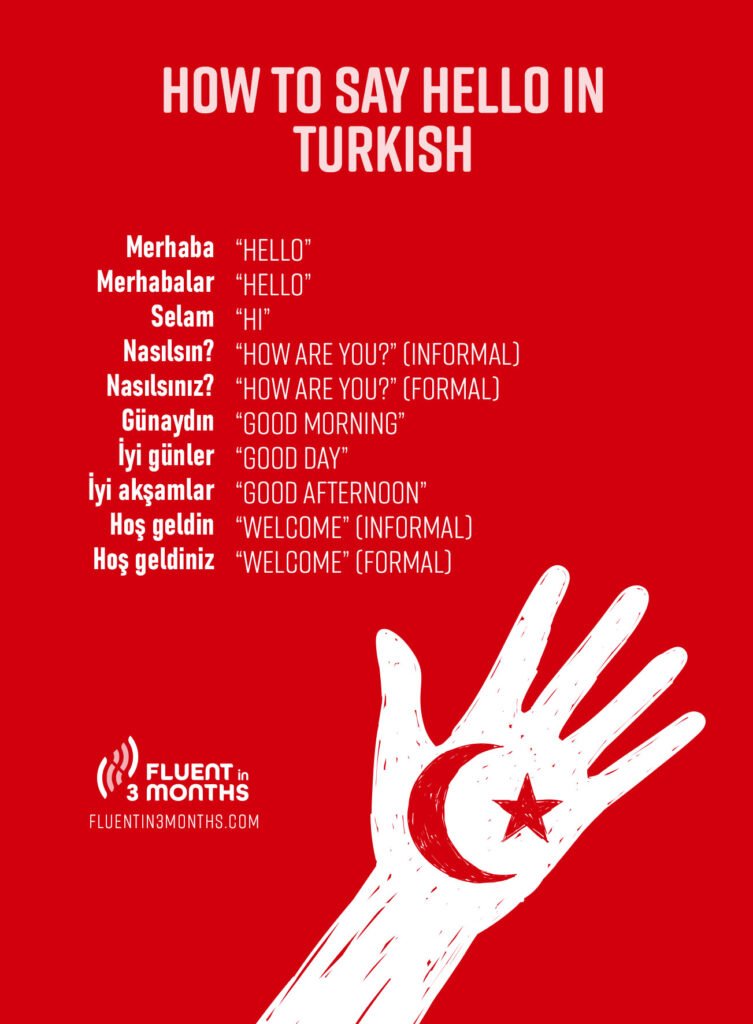
Merhaba means “hello” and works in a remarkably wide range of situations. You can use it when entering a shop, meeting someone for the first time, answering a casual greeting, or beginning a more polite conversation.
Merhaba
Pronunciation: mehr-hah-bah
Meaning: Hello
Turkish educational and language-learning resources consistently list merhaba as the standard general-purpose greeting, alongside time-specific expressions such as günaydın, iyi günler, and iyi akşamlar.
Picture a simple situation. You walk into a small hotel lobby in Istanbul at 11:00 a.m. You don't need to calculate the exact social register or construct a formal sentence.
Just say:
Merhaba.
That's enough to open the door.
One common beginner mistake is treating merhaba as stiff or excessively formal. It isn't. It may sound a little more neutral than selam, but neutral is useful. Especially while you're still learning.
From sunrise onward: Günaydın
Morning has its own greeting:
Günaydın
Pronunciation: roughly goon-eye-duhn
Meaning: Good morning
You'll hear it at breakfast, when arriving at work, when greeting a teacher, or when walking into a café early in the day. The same phrase can work across casual and professional settings.
A tiny pronunciation detail trips up English speakers: Turkish ü isn't the same as the English “oo.” Don't obsess over it on day one, though. Clear communication beats spending five minutes trying to produce a perfect vowel while everyone waits.
A natural exchange looks like this:
A: Günaydın!
B: Günaydın!
Short. Clean. Done.
You can also hear Günaydın, nasılsın? among friends.
That brings us to another useful distinction: nasılsın? means “How are you?” when speaking informally to one person, while nasılsınız? is the polite or plural form. Turkish learning materials regularly contrast these two forms, making them an early example of how the language marks informal and respectful address.
Midday gets messy: İyi günler and Tünaydın
English has a comfortable “good afternoon.” Turkish usage isn't always so neatly packaged.
İyi günler means roughly “good day” or “have a good day.” It's useful during the daytime and can function as either a greeting or a farewell.
İyi günler!
Pronunciation: ee-yee goon-ler
A Turkish speaker behind a shop counter may say it as you enter. The same person might use it as you leave.
Convenient.
You may also encounter tünaydın, often translated as “good afternoon.” It appears in Turkish teaching materials, although merhaba or iyi günler can be easier, safer choices for learners who don't yet have a feel for regional habits and personal preferences.
So, for practical purposes:
Situation | Natural option |
|---|---|
General daytime greeting | Merhaba |
Morning | Günaydın |
Daytime greeting or farewell | İyi günler |
Afternoon, in some contexts | Tünaydın |
Don't turn this into a clock-watching exercise. Native interaction is messier than a phrasebook chart.
Evening: İyi akşamlar
As the day winds down, use:
İyi akşamlar
Pronunciation: ee-yee ahk-shahm-lar
Meaning: Good evening
This is particularly useful when entering a restaurant, greeting a neighbor, beginning an evening phone call, or arriving at a hotel later in the day. Language resources also note that iyi akşamlar can work as both a greeting and a farewell.
Try this:
İyi akşamlar. Bir masa var mı?
Good evening. Is there a table available?
You don't need to understand every word yet. The point is rhythm. A greeting isn't isolated vocabulary; it is the first brick in a real interaction.
And no, İyi geceler isn't usually your “hello”
Here's where beginners often stumble.
İyi geceler means “good night.”
You'd normally use it when saying goodbye late at night or when someone is going to sleep, rather than walking into a bakery at 9 p.m. and greeting the cashier.
For an evening arrival, iyi akşamlar is generally the safer choice. For a late-night departure or bedtime, use iyi geceler.
Small distinction. Big difference in sounding natural.
Selam: the relaxed “hi”
If merhaba is the dependable all-purpose greeting, selam is its more casual cousin.
Selam!
Meaning: Hi!
You'll hear it between friends, classmates, and people who already have an informal relationship. Official and educational phrase collections list selam alongside merhaba, with merhaba generally serving as the more neutral option.
A casual exchange might be:
Selam, naber?
Hey, what's up?
Here, naber? is a conversational shortening of ne haber?, literally something like “what news?” but used much like “what's up?” Turkish learners also encounter ne var ne yok? and nasıl gidiyor? in everyday conversational materials.
I'd avoid forcing these into your speech after learning them once. That's a classic learner move: memorize one casual expression and then deploy it everywhere with alarming enthusiasm.
Start with selam. Listen. Notice what people around you say.
Then expand.
Turkish greetings aren't just about time
A phrase can also reflect the situation.
Hoş geldin / Hoş geldiniz
When welcoming someone, Turkish uses:
Hoş geldin — Welcome, to one person informally
Hoş geldiniz — Welcome, politely or to more than one person
The expected reply is usually:
Hoş bulduk — roughly, “Glad to be here” or the conventional response to “welcome.”
That exchange is worth memorizing as a pair rather than as separate vocabulary items. Turkish beginner materials explicitly teach hoş geldiniz → hoş bulduk as a conventional greeting-response combination.
Then there's kolay gelsin.
Literally, it carries the sense of “may your work come easily,” but you'll hear it directed at people who are working: a shopkeeper, delivery worker, taxi driver, colleague, or someone visibly busy. It can even function as a greeting or farewell in those situations.
Walk into a neighborhood shop. The owner is stocking shelves.
Kolay gelsin.
That sounds far more context-aware than mechanically repeating merhaba every time.
Formal versus informal: one detail that matters
Turkish makes a clear distinction between informal sen and polite or plural siz. Greetings often reflect that difference.
Informal | Polite or plural |
Nasılsın? | Nasılsınız? |
Hoş geldin | Hoş geldiniz |
Hoşça kal | Hoşça kalın |
The distinction isn't just grammar homework. It affects how natural your speech sounds with teachers, older people, strangers, customers, and groups. Turkish curriculum and beginner materials specifically highlight these informal/formal contrasts in greeting situations.
If you're unsure, polite language is usually the safer starting point.
You can relax later.
Don't forget the exit
A good greeting deserves a good goodbye.
Two expressions confuse almost everyone at first:
Hoşça kal — said by the person leaving, roughly “stay well.”
Güle güle — traditionally said by the person staying to the person who is leaving, roughly “go smiling” or “go happily.”
That speaker-direction distinction appears in practical Turkish phrase guides and beginner materials.
So the exchange can go:
Leaving person: Hoşça kal!
Person staying: Güle güle!
You'll also hear görüşürüz, meaning “see you,” and sonra görüşürüz, meaning “see you later.” Both are useful, friendly options for everyday conversation.
A simple dawn-to-dusk cheat sheet
Here’s the version worth saving:
Günaydın — Good morning
Merhaba — Hello; safe almost anytime
Selam — Hi; casual
İyi günler — Good day; useful during the daytime and as a farewell
Tünaydın — Good afternoon; heard in some contexts
İyi akşamlar — Good evening
İyi geceler — Good night
Kolay gelsin — May your work be easy; useful when addressing someone working
Hoş geldiniz — Welcome
Hoş bulduk — Conventional reply to “welcome”
FAQ: Saying Hello in Turkish
What is the most common way to say hello in Turkish?
Merhaba is the safest all-purpose choice. Use it with strangers, acquaintances, shop staff, and in many everyday situations.
Is “selam” rude?
No. Selam is casual rather than rude. It works well with friends and peers, but merhaba is the safer option when you're unsure about the setting.
How do I say “how are you?” in Turkish?
Use Nasılsın? with one person informally. Use Nasılsınız? when speaking politely or to more than one person.
What should I say when someone says “Hoş geldiniz”?
Reply with Hoş bulduk. It's a conventional response that beginner Turkish resources teach as part of the greeting pair.
Can I use “iyi geceler” to greet someone at night?
Usually, iyi geceler is better for saying good night when leaving or going to sleep. For greeting someone in the evening, iyi akşamlar is generally more natural.
The easiest next step is also the one most learners skip: use one greeting for a full week. Say günaydın every morning, switch to iyi akşamlar in the evening, and keep merhaba ready whenever your brain goes blank. After enough real repetitions, the phrases stop feeling like vocabulary. They start sounding like yours.
hello in Turkish
Turkish greetings
how to say hello in Turkish
Turkish phrases
Turkish language
good morning in Turkish
good evening in Turkish
learn Turkish
Found this helpful? Share it!