
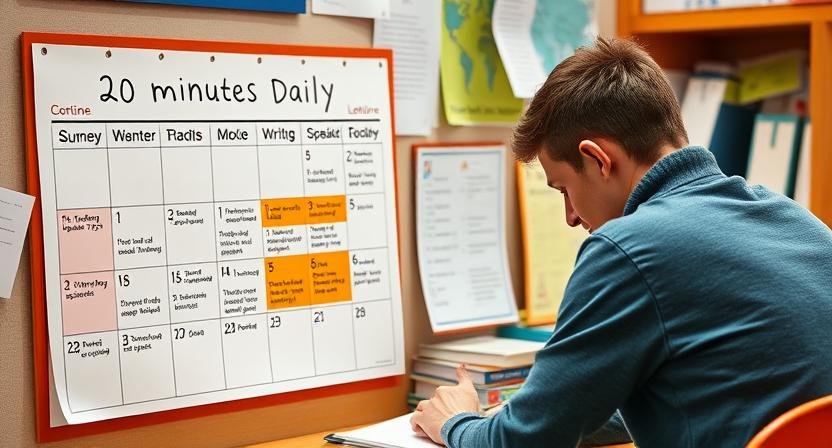
How to Build a Daily Routine for Language Fluency in Just 20 Minutes a Day
437 views
You download a language app. You feel motivated. Three days later, the streak is still alive—but you can't remember how to say anything useful outside the exercises.
Annoying, isn't it?
The problem usually isn't a lack of motivation. It's that many language routines confuse activity with training. Tapping through ten vocabulary cards, completing a few multiple-choice questions, and watching half a video can feel productive while doing surprisingly little for the skill that matters: retrieving language quickly enough to understand and respond in real situations.
Twenty minutes can work.
Not because 20 minutes is magical. Because a short routine can be repeated often enough to create the ingredient most learners are missing: frequent, structured contact with the language.
For readers of LanguageFluency.net, the goal isn't to collect another list of apps. This is a practical micro-routine built around four jobs: retrieve, notice, understand, and produce. Each one earns its place.
Why 20 minutes can beat the "study when I have time" approach
A two-hour study session on Sunday feels serious. It also has a scheduling problem: real life.
Meetings run late. Dinner happens. You get tired. Suddenly Sunday disappears, and the language gets pushed to next week.
A 20-minute routine lowers the activation energy. You don't need to set up a desk, open five tabs, or decide what to study from scratch.
That last point matters more than people think.
Decision fatigue can quietly kill a study habit. If every session begins with, What should I learn today?, you're spending part of your limited attention before the actual learning starts.
Research on skill learning also supports the broad idea behind short, repeated practice. The spacing effect has been extensively documented: revisiting information across time generally produces better long-term retention than concentrating the same practice into a single massed session. Retrieval practice—trying to recall information rather than merely reviewing it—has also shown strong benefits for durable learning.
But there is a catch.
Twenty minutes of passive exposure is still twenty minutes of passive exposure.
The routine needs friction. Productive friction.
You should have to remember, predict, imitate, and occasionally get stuck.
The 20-minute language fluency routine
Here's the basic structure:
Time | Activity | Main purpose |
|---|---|---|
0–4 min | Active recall | Strengthen accessible vocabulary |
4–9 min | Focused listening or reading | Build comprehension |
9–14 min | Shadowing or imitation | Connect perception to pronunciation |
14–20 min | Spoken or written output | Practice retrieval under pressure |
You don't need to follow these exact minutes forever. Think of them as guardrails.
The sequence, though, is useful.
Minutes 0–4: Recall before you consume
Start by producing language from memory.
If you're using Anki, this might mean reviewing a small deck with typed answers or cards that require you to say the answer aloud before revealing it. Anki's desktop software currently supports scheduling algorithms based on its traditional scheduler and FSRS, a newer free spaced-repetition scheduling option designed to adapt intervals to your review history.
Don't create a monster deck.
Ten to twenty meaningful reviews can be enough for this part of the session. The aim isn't to see the largest possible number of cards. It's to retrieve something accurately.
For example, instead of learning:
prendre = to take
use a prompt with a situation:
"What would you say if you wanted to take the train?"
Now you're recalling language with a purpose.
A small but common mistake: learners keep adding new cards because adding feels like progress. Then the review backlog arrives like unpaid bills. Keep new material modest enough that tomorrow's session still fits inside the same 20-minute window.
Minutes 4–9: Use one piece of understandable input
Choose a short clip, podcast segment, dialogue, or article that is slightly challenging but not incomprehensible.
Five minutes is plenty.
For video-based learners, YouTube can work well because playback speed, captions, and short clips let you revisit difficult material quickly. If you're studying with a podcast, pick one segment rather than pressing play and hoping comprehension improves through sheer optimism.
It won't. At least, not efficiently.
Try this sequence:
Listen or read once without pausing.
Write down or mentally note what you understood.
Check one or two gaps—no more.
Listen again.
The temptation is to translate every unknown word. Resist it.
If a three-minute clip contains twelve unfamiliar expressions, you do not need twelve dictionary detours. Select the words or phrases that are frequent, useful, or blocking comprehension.
Context beats hoarding.
Minutes 9–14: Shadow, imitate, and steal the rhythm
This is where the routine starts to feel less like studying.
Take one or two sentences from your input and imitate them aloud. Shadowing can mean speaking almost simultaneously with the recording, while a simpler version is to pause, replay, and repeat.
Don't chase a perfect accent.
Listen for rhythm, vowel length, stress, linking, and the way words change when they're spoken at normal speed. A sentence often sounds easy when printed and completely different when compressed by a native speaker.
That disconnect is normal.
For example, English learners may know every word in "What are you going to do?" but struggle with how connected speech can reduce it in fast conversation. Similar reductions and linking patterns exist across languages.
Use your phone's voice recorder.
Yes, your own voice will probably sound strange at first. Everyone hates this stage a little. Record one attempt, listen back, then make one adjustment. Maybe your rhythm is too slow. Maybe you're stressing the wrong syllable.
Fix one thing.
Not seven.
Minutes 14–20: Produce language without a safety net
The final six minutes are the fluency portion.
Put the notes away and answer a prompt aloud or in writing. Base it on the material you just encountered so the vocabulary has somewhere to go.
Suppose your input was a short Spanish video about ordering food. Your task might be:
Explain what you usually order at a restaurant and what happened the last time you ate out.
Try to keep talking.
When you hit an unknown word, paraphrase. Describe around it. Substitute a simpler expression.
That's a real fluency skill.
You can record a 60–90 second monologue using your phone, write a short entry in a notes app, or exchange messages with a language partner. If you use AI conversation tools, give them a specific role: ask follow-up questions, interrupt naturally, correct only recurring errors, or keep the conversation at approximately your current level.
Vague prompts produce vague practice.
Build the routine around a weekly loop
Doing exactly the same exercise every day gets stale. Total randomness isn't much better.
A simple weekly rotation keeps the habit stable while changing the material.
Monday: Everyday life
Food, work, commuting, errands, routines.
Tuesday: Listening day
Spend more of the 20 minutes on a single audio clip. Replay it. Predict what comes next. Copy a few useful phrases.
Wednesday: Conversation repair
Practice the language you need when communication breaks down:
"Could you say that again?"
"What do you mean by...?"
"I'm not sure I understood."
"How do you say ___?"
These phrases are oddly neglected. They're also extremely useful.
Thursday: Storytelling
Describe something that happened recently.
Past events force you to connect ideas, choose time markers, and maintain a sequence. Much better than reciting isolated vocabulary.
Friday: Review and remix
Return to material from earlier in the week.
Use old vocabulary in a new situation. If you learned travel phrases on Monday, imagine missing a train on Friday. Change the context.
That variation makes retrieval harder—and that's partly the point.
Weekend: Keep it lighter
If weekends are busy, don't turn Saturday and Sunday into failure days.
Use a "maintenance version":
5 minutes recall + 5 minutes input + 5 minutes imitation + 5 minutes output.
Still 20 minutes. Less pressure.
Pick tools that reduce friction, not add it
The best setup is usually boring.
Anki can handle spaced repetition. A podcast app or YouTube can provide input. Your phone's built-in recorder can capture speaking practice. A simple notes app can hold prompts and useful phrases.
That's enough.
Duolingo, Babbel, Memrise, and similar platforms can also fit into a routine, but don't let the app's structure become your entire definition of progress. A completed lesson isn't automatically a transferable skill.
The same issue appears with streaks.
A 100-day streak looks impressive. Ask a harder question: can you describe yesterday in your target language without opening the app?
If the answer is "not really," change the practice—not the streak counter.
Track one fluency metric that actually means something
Avoid complicated dashboards unless you genuinely enjoy them.
Instead, record one of these each week:
How long you can speak continuously on a familiar topic.
How many times you needed to switch back to your native language.
How much of a familiar podcast segment you understood without captions.
How quickly you could answer a recurring conversational question.
Here's a useful test.
Every Sunday, answer the same question for two minutes:
"Tell me about your week."
Record it.
Don't judge every grammatical error. Compare recordings over four to eight weeks. You'll hear changes that daily practice often hides: fewer long pauses, faster retrieval, better sentence linking, and more comfort with imperfect language.
Progress is often audible before it feels obvious.
What usually breaks a 20-minute routine
The first problem is overloading it.
If your routine contains vocabulary, grammar exercises, pronunciation drills, three podcasts, a lesson, journaling, and a conversation exchange, it isn't a 20-minute system anymore. It's a to-do list wearing a productivity hat.
The second problem is using difficult material because it feels more serious.
Too difficult means you spend the session decoding instead of practicing. Too easy becomes autopilot. Adjust until you understand enough to follow the general meaning while still encountering useful gaps.
Then there's the missed-day spiral.
You skip Tuesday. Wednesday feels like a restart. Thursday gets skipped because you're "behind."
You're not behind.
Resume.
No punishment session. No doubling tomorrow's workload. Just do the next 20 minutes.
FAQ
Can I really become fluent with only 20 minutes a day?
Twenty minutes a day can build meaningful skill, especially when practiced consistently, but the time required for fluency depends on your starting point, target language, definition of fluency, and access to real interaction. Think of the routine as a dependable core, not a mathematical guarantee.
Should beginners follow the same routine?
Yes, with simpler material. A beginner might spend the input section on a short dialogue and the output section producing five connected sentences rather than a two-minute monologue.
Is it better to study vocabulary every day?
Daily vocabulary review can help, especially with spaced repetition, but vocabulary should regularly move into listening, speaking, reading, and writing. A word you recognize on a flashcard isn't necessarily a word you can retrieve during conversation.
What if I only have 10 minutes?
Cut the routine in half rather than abandoning it. Spend two minutes recalling, three minutes on input, two minutes imitating, and three minutes producing.
Tiny sessions still count.
Should I study grammar during the 20 minutes?
Yes, selectively. Use grammar to solve problems you keep encountering rather than automatically giving it a fixed daily block. If you repeatedly struggle with past tense forms, spend a few sessions addressing that specific weakness, then return to meaningful use.
Start tomorrow with less, not more
Don't spend an hour designing the perfect language system.
Pick one short piece of input. Choose ten review items. Record yourself speaking for one minute.
Set a timer for 20 minutes and begin.
After seven days, change the parts that created friction. Maybe Anki took too long. Maybe the podcast was absurdly difficult. Maybe speaking felt intimidating, but that probably tells you exactly where the practice is needed.
Keep the routine small enough to survive an ordinary Tuesday.
That's where fluency habits are built.
daily language routine
language fluency
learn a language daily
20 minutes a day
language learning routine
improve language skills
daily language practice
language learning tips
Found this helpful? Share it!