
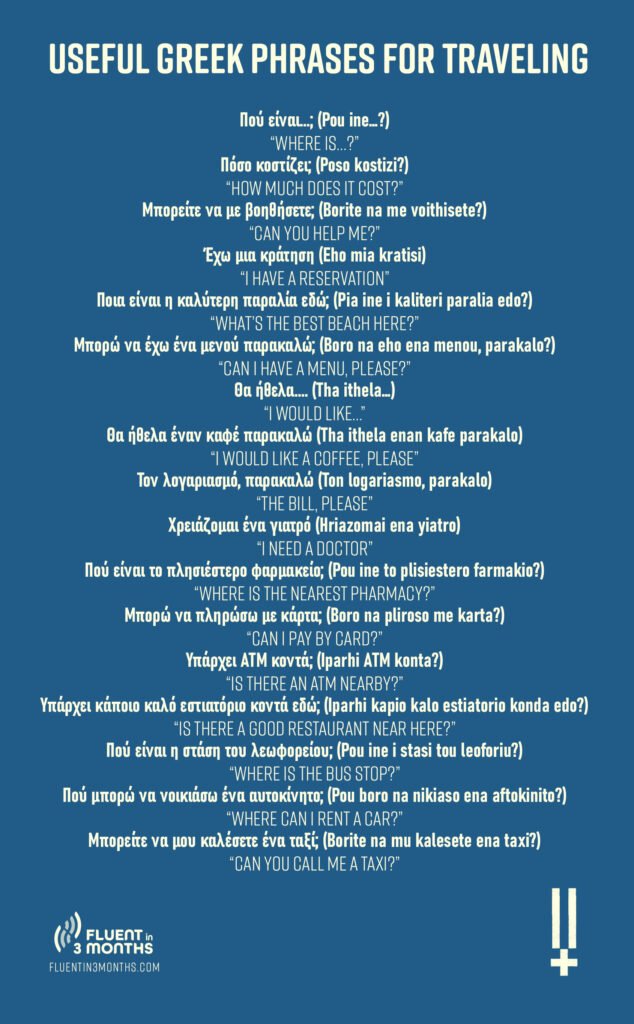
Must-Know Greek Phrases for Travelers and Learners
515 views
Landing in Greece with only hello and thank you in your vocabulary can get awkward surprisingly fast.
The café menu is entirely in Greek. Your taxi driver asks a question you didn't catch. Someone says something that sounds like a greeting, but you aren't sure whether to answer γεια, καλημέρα, or just smile and hope for the best.
A few well-chosen Greek phrases solve a lot of that friction.
This isn't meant to replace a full Greek course. It's a practical phrase guide for travelers who want to order food, ask for directions, pay for something, and handle small everyday interactions without reaching for a translation app every thirty seconds. For learners, the same phrases offer something equally useful: high-frequency language you can start hearing and reusing immediately.
Modern Greek can look intimidating at first because of its alphabet. The good news? You don't need to master every grammar rule before your trip.
Start with the phrases people actually use.
First, one small thing: you're learning Modern Greek
The Greek spoken in Athens, Thessaloniki, Crete, Rhodes, and most of modern Greece is Modern Greek (Νέα Ελληνικά, Néa Elliniká).
That's different from Ancient Greek.
A traveler doesn't need to worry about classical forms, ancient verb endings, or whether something appears in Homer. If you're learning from a language app, phrasebook, or tutor, look for Greek / Modern Greek rather than Ancient Greek.
One pronunciation wrinkle catches beginners immediately: several letter combinations produce sounds that don't match English expectations. For example, αι is pronounced roughly like the e in bed, while ου sounds like oo in food.
You'll make mistakes.
Everybody does.
The useful part is that Greek speakers generally understand what you're trying to do long before your pronunciation becomes polished.
The greetings you'll use constantly
Let's start with the phrases that get the most mileage.
Greek | Transliteration | English |
|---|---|---|
Γεια σου | Yia sou | Hi / Hello, informal |
Γεια σας | Yia sas | Hello, formal or plural |
Καλημέρα | Kaliméra | Good morning |
Καλησπέρα | Kalispéra | Good evening |
Καληνύχτα | Kaliníkhta | Good night |
Τι κάνεις; | Ti kánis? | How are you? |
Καλά, ευχαριστώ | Kalá, efharistó | Fine, thank you |
Χάρηκα | Hárika | Nice to meet you |
Γεια σου is the friendly, informal option for one person. Γεια σας works when speaking politely to one person or casually to more than one person.
That tiny difference matters.
A shopkeeper, hotel receptionist, or older person might be addressed with γεια σας, while γεια σου feels natural among friends or peers.
Don't overthink it, though. A warm greeting beats perfect grammar followed by total silence.
The survival phrases: please, thanks, and “I don't understand”
If you memorize only a handful of expressions, make them these.
Παρακαλώ (Parakaló) — Please / You're welcome
Ευχαριστώ (Efharistó) — Thank you
Συγγνώμη (Signómi) — Excuse me / Sorry
Δεν καταλαβαίνω (Den katalavéno) — I don't understand
Μιλάτε αγγλικά; (Miláte angliká?) — Do you speak English?
Μπορείτε να μιλήσετε πιο αργά; (Boríte na milísete pio argá?) — Can you speak more slowly?
That last phrase is especially useful for language learners.
Translation apps can translate a written menu fairly well. Real conversation is messier. A server may answer your carefully rehearsed question at normal speed, and suddenly every familiar word seems to vanish.
Instead of panicking, use Δεν καταλαβαίνω.
Then slow the conversation down.
Ordering food without pointing at everything
Greek food is one of the best reasons to learn a few phrases before visiting. Yes, you can point. Yes, many restaurants have English menus.
Still, ordering in Greek changes the interaction.
Try these:
At a café or taverna
Θα ήθελα... (Tha íthela...) — I would like...
This is your workhorse phrase.
You can follow it with almost anything:
Θα ήθελα έναν καφέ. — I'd like a coffee.
Θα ήθελα νερό. — I'd like water.
Θα ήθελα αυτό, παρακαλώ. — I'd like this, please.
A few other useful words:
Greek | Transliteration | Meaning |
Έναν καφέ, παρακαλώ | Énan kafé, parakaló | A coffee, please |
Νερό | Neró | Water |
Το μενού, παρακαλώ | To menú, parakaló | The menu, please |
Τον λογαριασμό, παρακαλώ | Ton logariasmó, parakaló | The bill, please |
Είναι πολύ νόστιμο | Íne polí nóstimo | It's very delicious |
Καφές deserves its own warning: ordering coffee in Greece isn't always as simple as saying “coffee.”
You may see or hear terms such as espresso, freddo espresso, freddo cappuccino, and ελληνικός καφές (ellinikós kafés, Greek coffee). If you know exactly what you want, say the drink name after Θα ήθελα.
Simple.
Asking for directions when Google Maps isn't enough
GPS is helpful until it isn't.
A narrow street, a confusing ferry terminal, or a destination pinned on the wrong side of a pedestrian zone can turn a two-minute walk into a small expedition.
Keep these phrases ready:
Πού είναι...? (Poú íne...?) — Where is...?
Examples:
Πού είναι η τουαλέτα; — Where is the toilet?
Πού είναι το ξενοδοχείο; — Where is the hotel?
Πού είναι η στάση; — Where is the stop?
You can also ask:
Πώς πάω στο κέντρο; (Pos páo sto kéntro?) — How do I get to the center?
And if the response becomes a blur:
Πιο αργά, παρακαλώ. (Pio argá, parakaló.) — More slowly, please.
That phrase may save you from confidently walking in the exact opposite direction.
Numbers matter more than beginners expect
Numbers appear everywhere: prices, bus platforms, room numbers, departure times, and addresses.
Start with one through ten.
ένα — éna
δύο — dýo
τρία — tría
τέσσερα — téssera
πέντε — pénte
έξι — éxi
επτά — eptá
οκτώ — októ
εννέα — ennéa
δέκα — déka
You don't need to recite them flawlessly.
Recognition comes first. If a cashier says a number you recognize, or you can confirm a price by repeating it back, you've already made the interaction easier.
A quick pronunciation reality check
Romanized spellings are useful, but they have limits.
The Greek letter χ can sound somewhat like a rough h or the sound in the Scottish pronunciation of loch, depending on the surrounding vowel. θ is pronounced like th in think, while δ is closer to th in this.
Then there's γ.
Before certain vowels, it doesn't always behave like the hard g English speakers expect.
Rather than obsessing over phonetics, combine three tools:
Learn the Greek spelling.
Listen to native audio.
Repeat short phrases aloud.
A platform such as Forvo can be useful for checking individual-word pronunciation, while Google Translate can provide quick text translation and text-to-speech support. Neither replaces conversation practice, but both can reduce the “wait, how do I actually say this?” problem.
Don't learn phrases as isolated flashcards
This is where many learners get stuck.
They memorize ευχαριστώ. Great. Then συγγνώμη. Also useful.
But isolated vocabulary doesn't prepare you for an actual exchange.
Build tiny conversation chains instead.
For example:
Γεια σας. Θα ήθελα έναν καφέ, παρακαλώ.
Hello. I'd like a coffee, please.
Then add:
Ευχαριστώ. Πόσο κάνει;
Thank you. How much is it?
That second phrase, Πόσο κάνει; (Póso káni?), means “How much is it?”
Suddenly you're not memorizing three disconnected facts. You're practicing a situation.
For travelers, this is faster. For serious learners, it also creates reusable language patterns rather than a pile of vocabulary cards you recognize but never say.
Useful Greek phrases for the moments nobody plans for
Trips rarely follow the script.
Your luggage doesn't arrive. You need a pharmacy. Your phone battery is dying. Somebody asks you something after you've confidently introduced yourself and you catch precisely nothing.
A few phrases for those moments:
Greek | Transliteration | English |
Χρειάζομαι βοήθεια | Hriázome voíthia | I need help |
Πού είναι το φαρμακείο; | Poú íne to farmakío? | Where is the pharmacy? |
Έχασα το τηλέφωνό μου | Éhasa to tiléfono mou | I lost my phone |
Δεν μιλάω καλά ελληνικά | Den miláo kalá elliniká | I don't speak Greek well |
Μπορείτε να το γράψετε; | Boríte na to grápsete? | Can you write it down? |
The final phrase is underrated.
If you can't understand a place name, bus stop, or address, asking someone to write it can be far more useful than asking them to repeat it a fifth time.
Been there.
How travelers can turn these phrases into real Greek
A phrase list is only useful if the words survive contact with real life.
Try this before a trip:
Day 1: Learn greetings and polite expressions.
Day 2: Practice a café interaction from start to finish.
After that, add directions, numbers, and problem-solving phrases. Keep each practice session short enough that you actually repeat it tomorrow.
For learners planning to go beyond travel Greek, pay attention to recurring words inside phrases. You'll notice θέλω (thélo, “I want”), μπορώ (boró, “I can”), and είναι (íne, “it is”) appearing repeatedly in everyday language.
That's your bridge from memorized phrases to grammar.
Start pulling the phrases apart.
Then rebuild them with your own words.
FAQs about Greek phrases
Do I need to learn the Greek alphabet before visiting Greece?
No. A small set of Romanized phrases can help you get started. Learning the alphabet does make reading signs, menus, and place names easier, though, and the Greek alphabet is manageable in short daily sessions.
Is English widely spoken in Greece?
English is commonly used in many tourism-related settings, particularly hotels, restaurants, and popular destinations. Still, assuming everyone will be comfortable speaking English is a mistake. A few Greek phrases show courtesy and can help outside heavily tourist-focused areas.
Should I say “yassou” or “yassas”?
Use γεια σου (yia sou) for one person informally. Use γεια σας (yia sas) when speaking politely to one person or addressing multiple people.
What's the most useful Greek phrase for a restaurant?
Θα ήθελα... (Tha íthela...), meaning “I would like...,” is hard to beat. Add the item you want, then finish with παρακαλώ.
How long does it take to learn basic travel Greek?
A practical phrase set can be learned in days or weeks, depending on how much you practice. Reaching comfortable conversational ability takes longer because listening comprehension, vocabulary, pronunciation, and grammar develop at different speeds.
Start with ten phrases, then make them yours
Don't try to memorize an entire phrasebook on the flight.
Pick ten expressions you can imagine using on your first day. Say them aloud. Listen to native pronunciation. Put two or three together into tiny conversations.
Then, once you're comfortable, swap one word at a time.
Γεια σας. Θα ήθελα έναν καφέ, παρακαλώ. Ευχαριστώ.
That's already a real interaction.
Next time, replace the coffee with water. Then breakfast. Then a question about the bill. Small changes add up quickly, and before long, the phrases you memorized for survival start becoming building blocks for actual Greek.
That’s where the fun begins.
Greek phrases
learn Greek
Greek for travelers
essential Greek phrases
Greek language
Greek travel phrases
basic Greek
Greek vocabulary
Found this helpful? Share it!